

Somewhere in Newcastle this morning, somebody cancelled an appointment they had been waiting weeks for. Not because they stopped needing it, but because the closer it got, the louder the dread became.
The two things we hear most often from people who finally come in are "I know I've left it far too long" and "please don't judge me". Neither needs saying. Here's what dental anxiety actually is, what the evidence says helps, and what genuinely happens if you walk through the door after ten years away.
You are in far better company than you think
This isn't a niche problem, and it isn't a personality flaw. In the Adult Oral Health Survey 2021, 12% of adults in England with their own teeth scored 19 or more on the Modified Dental Anxiety Scale, the threshold that suggests extreme dental anxiety. Among women it was 16%; among men, 8%.
What that survey also shows is how closely anxiety tracks with staying away. Extreme anxiety was reported by 8% of people who attend for regular check-ups, 12% of occasional attenders, and 22% of those who only go when something is wrong. It was reported by 8% of adults who rated their oral health as good, and 35% of those who rated it as bad.
Read that the wrong way and it sounds like a telling-off. It isn't. It's the shape of a trap: the more you dread it, the longer you leave it, and the longer you leave it, the more there is to dread.

The cycle, and why it tightens
Researchers have a name for this — the vicious cycle of dental fear. You avoid an appointment, small problems quietly become bigger ones, the treatment eventually needed is longer and more involved than it would have been, and that experience confirms every fear that caused the avoidance in the first place. Round it goes.
Most anxious patients I meet aren't frightened of dentistry in the abstract. They're frightened of something specific and usually reasonable: an injection that didn't work properly, a dentist who carried on when they raised a hand, a childhood extraction, a comment about their teeth that landed badly and stayed. The fear is a memory doing its job. It just isn't very good at updating itself.
The only thing that reliably breaks the cycle is a visit that goes differently from the one you're bracing for. Which is why the first one is deliberately small.
It isn't only fear keeping people away
It's worth being honest that anxiety is one barrier among several. In the Adult Oral Health Survey 2023, published at the end of 2025, adults who attended infrequently gave three main reasons: 40% could not find a dentist, 31% could not afford the charges, and 27% did not feel they needed to go.
If you've been told to "just register somewhere" and found that harder than it sounds, you weren't imagining it. That's part of why the first conversation here is a free 15-minute phone or video call. It costs nothing, it commits you to nothing, and it means the step of finding out where you stand doesn't require sitting in a chair at all.
What actually happens at a first appointment
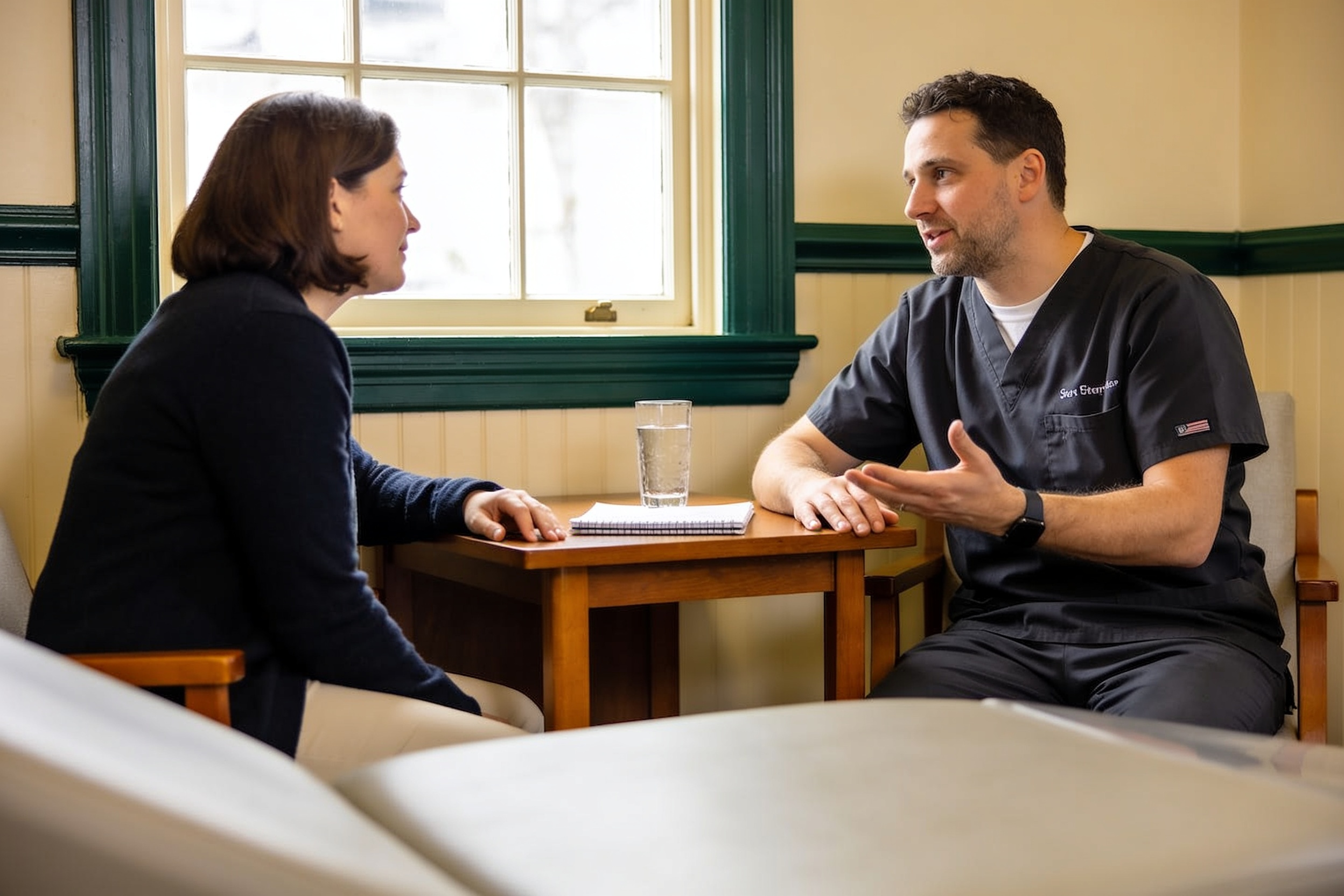
We talk first and look second. You get to explain what happened last time, what you're worried about, and what you'd rather I didn't do, before anything goes near your mouth.
Then it's a gentle look around, photographs, and a digital scan rather than the old impression trays that made people gag. X-rays only where they'd change the plan. Nothing is treated on the day unless you decide you want it treated on the day.
You leave with the whole picture in order of priority, and the costs written down. Not a lecture, and not a list of everything wrong presented as a moral failing. Problems get sorted in sequence: anything painful or infected first, health second, and cosmetic work last, if you ever want it at all.
And the thing anxious patients most want to hear: you will not shock me. Whatever is in there, I've seen it, I've seen worse, and I've seen it in people who went on to become the ones writing the nice reviews.
Things that genuinely help
These aren't special favours. Ask for any of them, at any practice, and a good one will simply say yes.
- Say it when you book, not when you arrive. It changes how much time gets set aside for you.
- Ask for the first appointment of the day. A whole day of anticipation is its own ordeal.
- Agree a stop signal. A raised hand stops everything immediately, every time, no discussion. Knowing you can stop is often why you don't need to.
- Bring headphones. Your own music or a podcast takes most of the sting out of the sound, which for many people is the worst part.
- Bring someone. Sitting in the room with you is allowed.
- Ask for the commentary you want. Some people want every step narrated in advance; others want none of it. Both are fine, but we can't guess which you are.
- Ask for it in small pieces. Short appointments, breaks by the clock, sitting up between stages. Two comfortable visits beat one heroic one.
- Ask about numbing before the numbing. Strong topical gel first, then a slow injection, makes a real difference to how the injection feels.
- Book the next one before you leave. The gap is where dread grows; a date already in the diary is much harder to talk yourself out of.
What people dread, and what can be done about it
| What you're dreading | What we can do about it |
|---|---|
| The injection | Topical gel first, a slow injection, and a warning before each step. Most people rate it far lower than they expected. |
| The sound of the drill | Noise-cancelling headphones and your own music. For small repairs there is often no drill involved at all. |
| Being judged | There's no lecture here. Everyone in the chair has a history, and my job is to fix things rather than grade them. |
| Not being able to stop it | An agreed hand signal that stops everything instantly, honoured every time. |
| Gagging | A scanner instead of impression trays, a more upright chair, shorter appointments and nose breathing. |
| The bill | Costs written down before anything starts, and treatment staged so you choose what happens and when. |
| Not knowing what's coming | A written plan, in order, saying what each visit involves and how long it takes. |
The fear itself is treatable
This is the part that rarely gets said: dental anxiety is a condition in its own right, and it responds to treatment. A systematic review of psychological treatment for dental anxiety in adults found that behavioural and cognitive behavioural approaches reduced anxiety and, importantly, that treated patients went on to attend. More recent work, including a 2024 meta-analysis of randomised trials and a review of management strategies in the dental clinic, points the same way.
The honest caveat is that much of this evidence is graded low to moderate quality, with small studies and inconsistent outcome measures. But the direction of travel is consistent, and the side effects of being taught to manage your own anxiety are essentially nil. Compared with most things in dentistry, that's a good trade.
In practice, the useful version of this is simple: graded exposure. A conversation, then a look, then a clean, then the thing you're actually dreading. Each step proves the last fear wrong before the next one starts.
What about sedation?
Sedation is a legitimate tool, and needing it is nothing to be embarrassed about. Inhalation sedation in particular has good evidence for reducing anxiety during treatment, and for some people it's the only way a first appointment happens at all.
The caveat is worth knowing: sedation gets you through the appointment, but it doesn't teach you anything that makes the next one easier. If someone is sedated for every visit for the rest of their life, the anxiety was never actually addressed. Used as a bridge rather than a permanent arrangement, it works well. Not every practice offers every route, so ask early.
If it's genuinely been ten years
Then you're the person this article was written for, and the honest answer is that the first appointment is the easy one. Looking doesn't hurt. Photographs don't hurt. A scan doesn't hurt.
What you'll get is a plan, in order, with prices, and permission to do it at your own pace. Some of it may turn out to be less than you feared; some of it may be more. Either way, you'll know, and knowing is the thing that stops the 3am version of your teeth being worse than the real ones.
Resources
- Adult Oral Health Survey 2021: service use and barriers to accessing care
- Adult Oral Health Survey 2023: service use and barriers to accessing care
- Psychological treatment of dental anxiety among adults: a systematic review
- Interventions to reduce adult state anxiety, dental trait anxiety and dental phobia: a systematic review and meta-analysis (2024)
- Effectiveness of behavioural therapy and inhalational sedation in reducing dental anxiety
Not ready to sit in a chair yet? You don't have to. Start with a free 15-minute phone or video consultation with Jack Dowling, private dentist in Newcastle. Tell us you're nervous when you book, and the appointment will be built around that from the start.
Wondering what’s right for your smile?
Book your free consultation →