

If your hands bled every time you washed them, you'd have done something about it by the end of the week. Gums somehow get a free pass. People see pink in the sink for years, decide they must be brushing too hard, and quietly brush that bit less.
Bleeding gums are not a brushing injury. They're inflammation, and inflammation is a message. Here's what it means, what the difference is between the version that reverses and the version that doesn't, and what actually works.
How common is this, really?
Very. The Adult Oral Health Survey 2023, the first clinical survey of adult mouths in England for well over a decade, examined around 1,600 adults with their own teeth. It found that 92.3% had some sign of gum disease or the things that drive it: bleeding, tartar, pocketing, recession, mobility.
More specifically, periodontal pocketing of 3.5mm or more — the point at which a dentist starts paying close attention — was present in 40.6% of adults, rising from 15.0% of 16 to 24-year-olds to more than half of everyone over 55. Deeper pocketing beyond 5.5mm affected 12.2% overall, and 22.6% of adults aged 65 to 74. One in five had visible recession between the teeth.
It's worth separating two ideas that get muddled here. Common and normal are not the same word. Grey hair is normal. Bleeding gums are common.
Gingivitis and periodontitis are not the same thing
This is the single most useful distinction in gum health, and almost nobody is told it clearly.
| Gingivitis | Periodontitis | |
|---|---|---|
| What's affected | The gum tissue only | The bone and fibres that hold the tooth in |
| What you'd notice | Redness, puffiness, bleeding when you brush or clean between | All of the above, plus recession, bad taste, gaps opening up, teeth drifting or loosening |
| Does it hurt? | Usually not | Usually not, until it's advanced — which is exactly the problem |
| Can it be reversed? | Yes, normally within a couple of weeks of proper cleaning | No. It can be stopped and stabilised, but lost bone doesn't grow back |
| What treatment involves | Better daily cleaning plus a professional clean | Full charting, cleaning below the gumline, tackling risk factors, then maintenance for life |
Why painless is the dangerous part
Decay eventually announces itself. Gum disease doesn't. Bone can be lost steadily for years with nothing more dramatic than a bit of blood on the brush and a taste you'd rather not think about, which is why people are so often astonished when a tooth that never hurt turns out to be loose.
The tell is bleeding, and it's a good one. Healthy gums do not bleed when they're cleaned properly, any more than healthy skin bleeds when you wash it. If yours do, something is going on at the gumline, and it started before you noticed it.
The worst possible reaction to bleeding
Which is, of course, the most common one: clean that area less. It makes intuitive sense and it's precisely backwards. The bleeding comes from plaque sitting undisturbed at the gum margin. Leave it alone and the inflammation gets worse, so it bleeds more, so you avoid it more.
Cleaning it thoroughly and gently is what stops it. Expect it to bleed for the first several days while you do — that's inflamed tissue, not damage — and expect it to settle within one to two weeks. If it hasn't settled by then, that's genuinely useful information, and it's worth having someone look.
Switching to a softer brush is sensible. Scrubbing harder is not: pressure doesn't clean the gumline, technique does, and hard scrubbing carves notches into the tooth at the very place you were trying to clean.
What actually works, roughly in order of impact
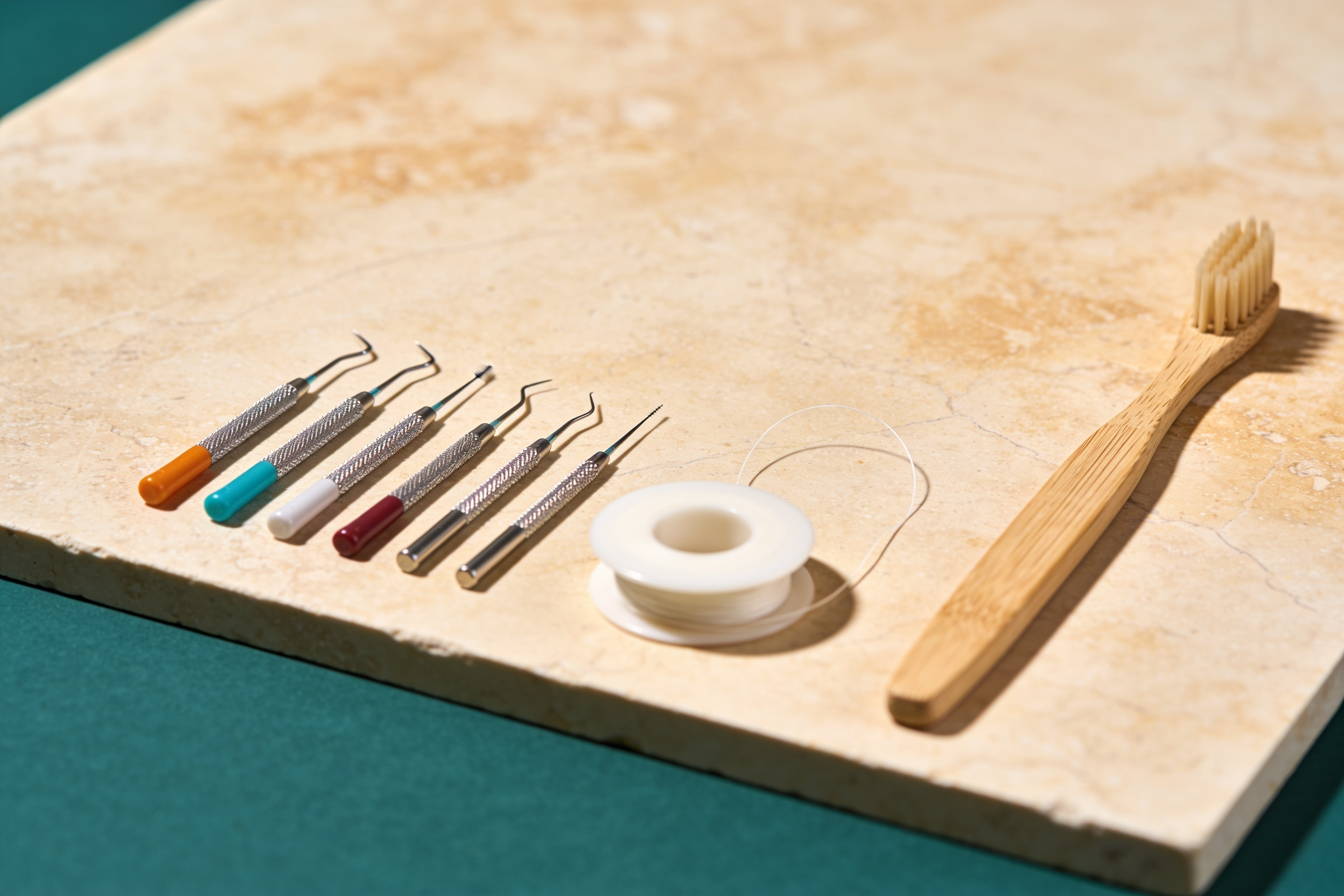
- Clean between your teeth once a day. A toothbrush cannot reach the surfaces where gum disease starts. The 2019 Cochrane review of interdental cleaning found that adding floss or interdental brushes to toothbrushing may reduce gingivitis more than brushing alone, and that interdental brushes may work better than floss. The evidence is graded low to very low certainty and mostly short-term, so treat it as a steer rather than a commandment — but it matches what we see in mouths.
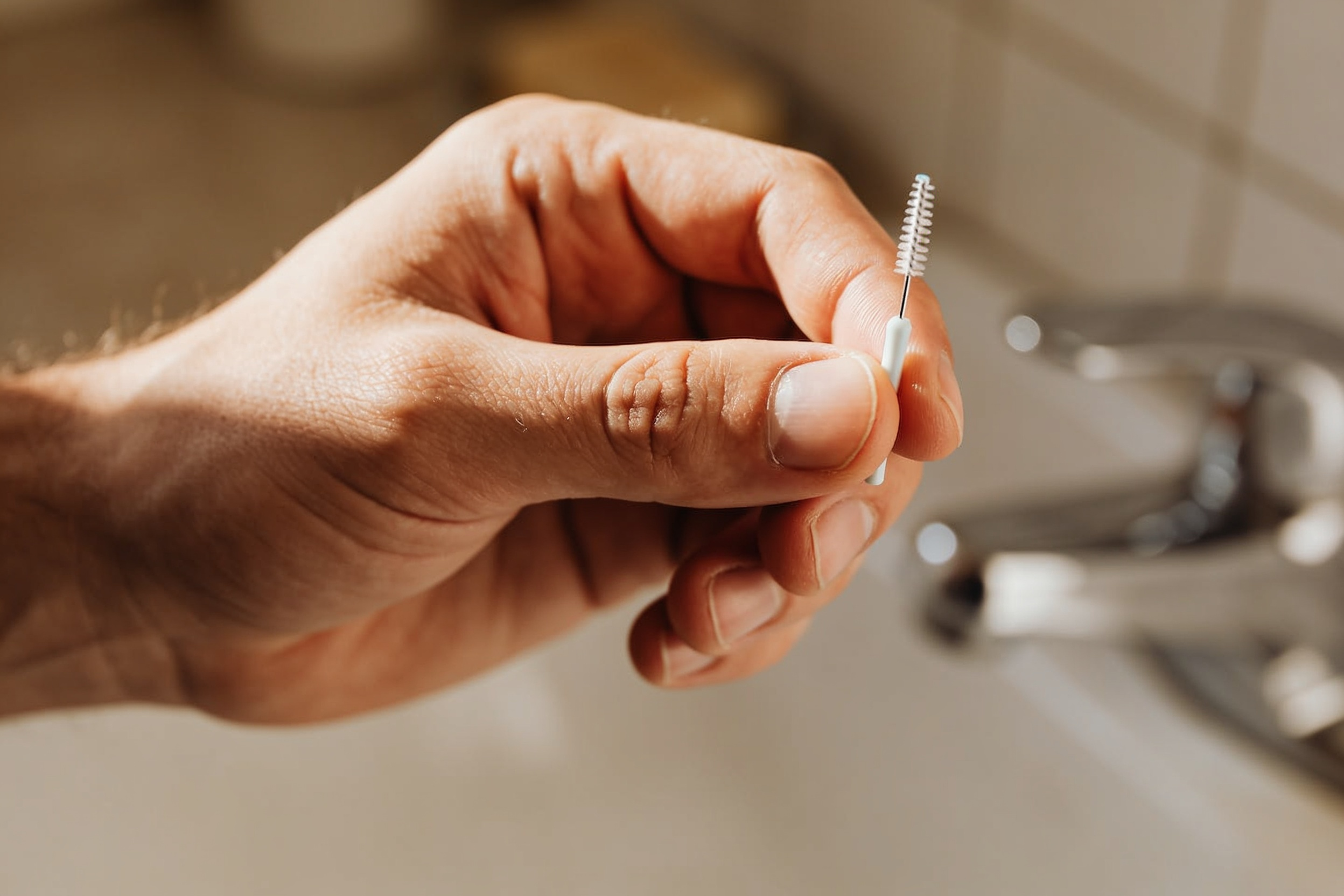
- Use the right size of interdental brush. The biggest one that slides in without being forced, and often that means several different sizes around one mouth. Floss where a brush genuinely won't fit.
- Brush twice a day for two minutes with fluoride toothpaste, angled into the gumline. Then spit, and don't rinse — rinsing washes away the fluoride you just paid for.
- Stop smoking, if you smoke. It's the biggest modifiable risk factor there is, and it comes with a nasty trick: nicotine narrows the small vessels in the gum, so smokers often bleed less while losing more bone. Treatment also works less well until you stop.
- Get diabetes well controlled — see below, because this one runs in both directions.
- Attend at the interval you're given, not the one you'd prefer. Three months is a real clinical recommendation for some people, not an upsell.
Your gums and the rest of you
The link between gum disease and diabetes is the best established of the whole-body associations, and it runs both ways. The joint consensus from the International Diabetes Federation and the European Federation of Periodontology reports strong evidence that people with periodontitis have a higher risk of raised blood sugar and insulin resistance, and a higher risk of developing type 2 diabetes.
The interesting half is what happens when the gums get treated. That same consensus found periodontal treatment was associated with HbA1c reductions of around 0.27 to 0.48% at three months, an effect the authors describe as comparable to adding a second drug to a diabetes regime. Cochrane has put it at roughly 0.3% at six months and 0.5% at twelve.
Gum disease has also been linked to cardiovascular and respiratory disease, and here I'd rather be precise than dramatic. The 2023 EFP and WONCA Europe consensus describes consistent associations and biologically plausible mechanisms, not proof that treating your gums prevents heart attacks. What it does support is that this is a chronic inflammatory disease worth taking seriously, rather than a cosmetic nuisance about blood on a toothbrush.
What treatment actually looks like
First, measurement. Six points around every tooth, recorded, so that there's a baseline instead of an opinion. Photographs, and X-rays where bone levels need checking.
Then the cause: cleaning technique, the specific spots you're missing, smoking, diabetes control. This is the part patients often want to skip and the part that determines whether any of the rest holds.
Then cleaning below the gumline, usually over one or two longer appointments with the area numbed. Then a re-measurement around eight to twelve weeks later to see what responded and what didn't, and treatment of the sites that didn't. After that, maintenance at an interval set by your risk, not by habit.
The blunt version: the deep clean is half the treatment. The other half happens at your own sink, twice a day, for the rest of your life. A hygienist who tells you otherwise is being kind rather than accurate.
Two questions I'm always asked
Will my gums grow back? No. Recession is permanent, which is the strongest argument there is for dealing with this early rather than perfectly. Sensitivity from exposed roots can be managed well, and the recession itself can be stopped from progressing.
Can I have straightening, bonding or whitening while my gums are like this? Gums first, always. Straightening moves teeth through bone, and inflamed bone is not what you want to be moving them through. Whitening gel stings inflamed tissue. Bonding placed against a bleeding margin doesn't last. Sorting the foundation isn't a delay to cosmetic work — it's the first stage of it, whether you're considering aligners or braces, bonding or veneers.
Resources
- Adult Oral Health Survey 2023: report summary
- Adult Oral Health Survey 2023: periodontal disease and erosive tooth wear among adults in England
- Home use of interdental cleaning devices, in addition to toothbrushing — Cochrane review, 2019
- IDF and EFP consensus report on periodontal diseases and diabetes
- EFP and WONCA Europe consensus on periodontal disease and cardiovascular, diabetic and respiratory disease (2023)
Seeing pink in the sink? Get it measured rather than guessed at. Book a free 15-minute phone or video consultation with Jack Dowling, private dentist in Newcastle, and we'll tell you honestly whether this is two weeks of better cleaning or something that needs proper treatment.
Wondering what’s right for your smile?
Book your free consultation →